- The pump has to fit your skid, not just your duty point.
- Frequency and voltage decide where your system can ship.
- Wetted materials should match the liquid, not the catalogue average.
- Same pump, same performance, batch after batch.
Why the Pump Choice Lands on Your Name
When you build a booster set, a treatment skid, or a washing system, the pump is one component inside your product. The customer doesn’t see it that way. If the pump underperforms, it’s your brand on the complaint and your team on the call.
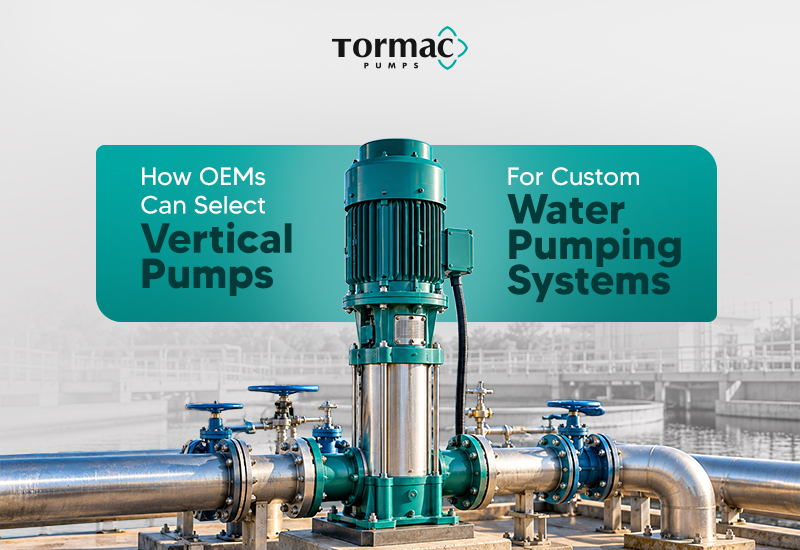
The true reason is why it becomes more important to give more attention to vertical pumps in water pumping systems during design. They pack a lot of pressure into a small space, they fit into the pipe, and they don’t take up a lot of floor space. Only if the model you choose really fits the job, the duty, and the market you’re sending to.
CHECK OUR PRODUCTS – Vertical Multistage Pumps
Start With What the System Really Does
A vertical multistage pump can be used for a pressure booster on a building, an RO feed skid, or an irrigation set, and each of these requires a different thing. One is continually and uniformly flowing throughout the day. The other one starts and stops 40 times per hour. A third requires pressure balancing.
Write down the real working range before you look at any model. Minimum and maximum flow, required pressure, how often it starts, and how many hours it runs. Pumps picked at a single duty point tend to look good on paper and behave badly in the field.
Fit the Skid, Not Just the Curve
This is where OEMs get caught out. The hydraulics can be perfect, and the pump still won’t go on the frame.
- Check the suction and discharge connection sizes and positions against your manifold design
- Check motor height and weight, since an inline vertical unit stands tall on a compact base
- Leave room for seal and motor servicing without pulling the whole skid apart
If you’re building multi-pump sets, think about how the units sit side by side, how the manifolds run, and where the control panel goes. Fixing this after the prototype is cheap. Fixing it after fifty units have shipped is not.
50Hz or 60Hz: Decide Before You Quote
Your motor frequency is as important as your hydraulics if you sell into more than one region. The flow, head, and power draw will all differ when a pump is wound for 50Hz and operated on a 60Hz grid. Cheaper to pick a supplier who makes separate 50Hz and 60Hz versions than to explain a performance gap to a customer overseas.
ALSO CHECK – The Ultimate Selection Chart for Submersible Pumps
Materials and Seals Follow the Liquid
Drinking water, treated water, mildly corrosive process water, and warm water. Each one requires a different type of wetted parts and shaft seal. When the water quality is important, or corrosion is a possibility, stainless steel is the common material of choice; cast iron is used for plain clean water where cost is a concern. We’ve written a blog to discuss where each one is appropriate for use.
Ask the supplier for the exact material grade of the parts that touch the liquid, plus the rated liquid temperature. A vague answer here usually means trouble later.
Selection Checklist: Vertical Pumps for Water Pumping Systems
|
Factor |
What to Confirm |
Why It Matters |
|
Duty Range |
Min and max flow, pressure, start frequency |
Avoids a pump that only suits one point |
|
Frame Fit |
Connection sizes, motor height, service space |
Saves a redesign after the prototype |
|
Power Supply |
50Hz or 60Hz, voltage, phase |
Decides which markets you can ship to |
|
Materials |
Wetted grade and liquid temperature |
Corrosion and seal life |
|
Consistency |
Batch-to-batch performance, test records |
Fewer warranty calls |
|
Branding |
OEM or private-label option |
Your name on the nameplate |
Consistency and Supply
Prototypes hide something. The first pump you test is usually the best one the supplier ever sends you. It’s batch ten that shows whether the factory is actually consistent.
So ask a few plain questions. Does every unit get tested before dispatch, or just a sample? Can you get the test record for your batch? And if you reorder in March, how long before pumps reach your assembly line? A pump that takes ten weeks to arrive holds up your whole product, however good its curve looks.
How Tormac Pumps Supports OEM Builders
At Tormac, we build inline TV Series vertical multistage pumps, vertical turbine pumps, and pressure boosting systems. Each comes in separate 50Hz and 60Hz versions, and production runs under ISO 9001:2015. Performance curves come with every series, so your engineers aren’t guessing at duty points.
If you’d like the pump to carry your own name, OEM and private-label options are there too. A tip from the technical team’s side: send your duty range and frame dimensions early. Narrowing down the model before the prototype costs far less than after it.
Final Thought
Get the vertical pumps for water pumping systems right, and most of the usual pain never shows up. Know your real working range. Check that the pump fits your skid. Sort out 50Hz or 60Hz before you quote. Match the materials to the liquid.
Then there’s the supplier, and that’s the hard one. Everything else you can check on paper. Whether the hundredth pump matches the first, you only learn by asking early.
Building a custom water pumping system? Reach out to the Tormac Pumps technical team for a model recommendation.
FAQs
1. Why are vertical multistage pumps the preferred choice of pumps for OEM booster sets?
They are small, they fit in line in pipework, and they can create a high pressure with minimal floor space. This means they fit easily on a skid.
2.But does 50Hz vs 60Hz really affect the pump performance?
Yes. Flow, head, and power draw change with frequency changes in motor speed. You can’t get the same numbers from a pump that was built for one grid to the other.
3. May I sell a Tormac pump as a brand?
OEM and private labels are both available. Call the Tormac team with your volume and specifications to get the details.