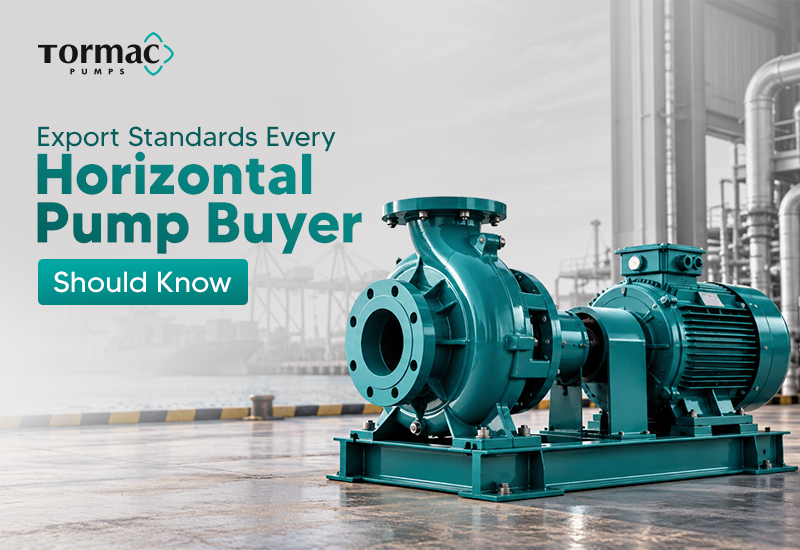
- Power standards, not just specs, decide whether a pump actually works at your site.
- Glossy brochures make promises; quality certifications prove them.
- Test documentation before shipment saves disputes after the container lands.
- Not every exporter builds for both 50Hz and 60Hz markets that matters more than it sounds.
Why Export Standards Deserve a Second Look
Buying a pump locally is one thing, you can walk the factory floor, run a demo, and sort out issues face to face. Buying across borders removes most of that safety net. By the time a shipment lands and something’s off, you’re dealing with freight costs, customs delays, and a supplier who may or may not answer the phone the same way they did during the sales pitch.
That’s exactly why picking the right horizontal pump exporter comes down to more than price per unit. A few standards and checks, done before the order is placed, decide whether the relationship works long-term or turns into a one-time headache.
CHECK OUR PRODUCTS – Horizontal Multistage Pumps
Power Standard: The First Thing to Confirm
This sounds obvious until it isn’t. India, most of Asia, Africa, and Europe run on 50Hz power, while North America and parts of Latin America run on 60Hz. A pump designed and wound for one won’t perform correctly on the other motor speed, flow output, and efficiency all shift.
A supplier that genuinely manufactures separate 50Hz and 60Hz product lines, rather than just re-labeling the same unit, is worth paying attention to. It’s a small detail that tells you whether engineering was actually done for your market or your order was an afterthought.
Quality Certification Isn’t Just a Logo
An ISO 9001:2015 certification guarantees that the manufacturing process is documented and audited, not a one-off inspection before shipment, but a consistent quality control system and steps that can be traced back to the manufacturing process. This is one of the few objective signals that are available to the buyer before placing a large order, when he cannot visit the factory.
Material certification is also important. If a supplier states “stainless steel” without explaining which grade is in which series, this is one example of a situation where he or she is misleading the customer. Stainless steel is a series of grades, each with its own properties, and each is different when subjected to corrosive or high-salinity water.
Ask for Test Documentation Before Shipment
Performance curves and factory tests should be available on request (not after the order is placed), and many horizontal pumps have standards such as ISO 2858 for mounting and footprint. When a supplier is reluctant to provide this, it’s often a sign that something is wrong.
- Factory test certificate matching the specific unit shipped
- Performance curve sheet for head, flow, and power at rated conditions
- Dimensional drawing confirming footprint and mounting compatibility
What to Look for in a Horizontal Pump Exporter
| Factor | What to Confirm | Why It Matters |
| Power Standard | Dedicated 50Hz / 60Hz product lines | Ensures correct performance for your grid |
| Certification | ISO 9001:2015 or equivalent | Signals audited, consistent manufacturing |
| Material Traceability | Exact grade (e.g. SS 304/316/904L) | Confirms suitability for local water conditions |
| Documentation | Test certificates, curve sheets | Reduces disputes after shipment |
| Track Record | Existing export markets and references | Shows real-world reliability, not just claims |
How Tormac Pumps Fits This Standard
Tormac manufactures separate 50Hz and 60Hz ranges across its horizontal pump lines, backed by ISO 9001:2015 certified production. The company ships to over 50 countries, including established markets across Africa, the Middle East, and Latin America, with material specifications and test documentation available for every series before an order is confirmed. OEM and private-label manufacturing options are also available for buyers building their own brand around Tormac-engineered products.
Final Thought
A horizontal pump exporter isn’t only about getting the best price, it’s about ensuring that the power standard is compatible with your grid, the certification is valid and up-to-date, materials are traceable, and paperwork verifies all the performance claims before the pumps leave the factory. Have those checks performed before you get the pump you requested.
Sourcing horizontal pumps for an export order? Reach out to the Tormac Pumps international team for documentation and a quote.
FAQs
1. Why does 50Hz vs 60Hz matter so much for imported pumps?
A pump built for the wrong frequency runs at the wrong speed, which throws off flow, head, and efficiency sometimes enough to damage the motor over time.
2. What should I ask an exporter for before placing a bulk order?
Request the ISO certification, material grade confirmation, a performance curve sheet, and a factory test certificate specific to your order.
3. Does Tormac provide OEM/PL manufacturing for export customers?
Yes, Of course buyers can also opt for OEM and private labels, in addition to the standard product line.