- Wrong stock, slow shelf, more warranty headaches.
- Water filled motors move fastest across Indian and export markets.
- Insulation class, seals, and HP range decide repeat orders.
- A quick checklist keeps stocking mistakes off your margins.
Why This Decision Matters for Dealers
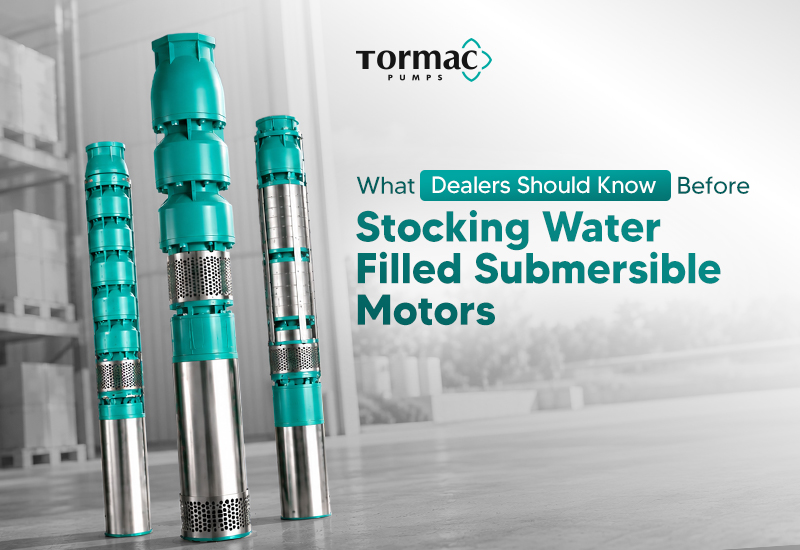
Stocking submersible motors is not just filling shelf space, it is working capital sitting there until it sells. Get the range wrong, and you’re either turning customers away who wanted a different HP, or you’re left with stock that simply doesn’t move.
Water-filled submersible motors happen to be the category most dealers reach for first, simply because they cover the widest range of everyday borewell needs for farms, homes, and small industries. But “stocking water filled motors” isn’t as simple as picking whatever the last supplier offered. A few checks upfront save a lot of return-and-replace headaches later.
ALSO CHECK – The Ultimate Selection Chart for Submersible Pumps
What to Check Before Placing a Stock Order
1. HP and Stage Range Matching Your Region
Not every region needs the same motor sizes. A borewell-heavy agricultural belt will move a lot of 1 HP to 5 HP motors, while industrial pockets ask for higher HP with 3-phase options. Before stocking, it helps to actually pull last year’s sales data or just ask around at the counter instead of guessing based on what a neighbouring dealer stocks.
2. Insulation Class and Winding Quality
This is the part customers rarely ask about but complain about the most when it fails. Class F or Class H insulation handles heat better over long duty cycles, and cheaper Class B windings tend to burn out faster under continuous farm use. If a supplier can’t tell you the insulation class on the spot, that’s usually a red flag.
3. Seal and Cable Quality
The rubber cable for lowering the motor down the borehole must withstand water pressure and years of sun exposure if left above ground. The main reason for water-filled motors fail early is a bad seal. Once water gets in past a bad seal in the wrong spot the winding is done for.
Dealers who’ve been in this business a while can usually tell a well-sealed motor just by the weight and finish, but it’s still worth asking the manufacturer directly about seal material and testing standards.
4. Warranty Terms and Replacement Turnaround
A motor with a longer warranty sounds nice, but what actually matters to a dealer is how fast a replacement or repair comes through when a customer walks in upset. Ask suppliers directly: what’s the average turnaround on a warranty claim? Some manufacturers take weeks, and that delay lands squarely on the dealer’s reputation, not theirs.
5. Availability of Matching Control Panels
Water-filled motors work best when paired with the right starter or control panel for dry-run protection, overload cutoff, and voltage correction. Stocking motors without matching panels usually means the customer buys the motor from you and the panel from someone else, and that’s a sale you didn’t need to lose.
Water Filled vs Oil Filled – What Dealers Should Stock More Of
| Factor | Water Filled Motors | Oil Filled Motors |
| Demand in India | High, especially agriculture and residential | Lower, niche cold-climate demand |
| Price point for customers | More affordable | Slightly higher |
| Return/complaint rate | Low, if seal quality is good | Moderate |
| Ideal dealer stock ratio | 70-80% of borewell motor stock | 20-30%, mainly for export or cold regions |
Most dealers end up stocking water-filled motors as the bulk of their range and keep a smaller oil-filled stock for specific customer requests that split works fine for most regions.
How Tormac Pumps Helps Dealers Stock Smarter
Tormac’s Eco Series covers 4-inch to 10-inch water-filled motors with Class F insulation as standard, so dealers aren’t left explaining a spec downgrade to customers. Each motor comes with matching control panel options, which means one stock order can cover both the pump and its protection accessory instead of chasing two suppliers.
Warranty support is handled through the regional dealer network directly, so replacement turnaround doesn’t drag on for weeks, something dealers quickly notice when a customer is standing at the counter waiting.
Final Thought
For stocking water filled submersible motors, it comes down to a few basics right HP range for your area, decent insulation class, a properly sealed motor, and a supplier who backs their warranty with no excuses. Get these right and repeat customers, fewer returns tends to sort itself out.
Want to review Tormac’s dealer stocking options? Reach out to the sales team for region-specific recommendations.
FAQs
- What HP range should a new dealer stock first?
Start with 1 HP to 5 HP water filled motors that’s what moves fastest in most agricultural and residential markets, then expand based on what customers actually ask for.
- How can dealers check motor quality before stocking in bulk?
Ask for the insulation class, seal testing details, and a sample unit if possible. A quick physical check on weight and finish tells you a lot too.
- Should dealers stock oil filled motors as well?
A small stock is worth keeping for customers with cold-region or export requirements, but water filled should make up the bulk of regular inventory.