- Sewage pumps move wastewater and solids where gravity cannot.
- They prevent wastewater overflow and protect public health.
- Different applications require different sewage pump models.
- Modern pumps offer clog-resistant, continuous operation.
- The right pump improves efficiency and reduces maintenance costs.
The Vital Role of Sewage Pumps in Modern Infrastructure
Every city, commercial complex, industrial facility, and residential building produces wastewater. What happens to it depends on one crucial piece of equipment: the sewage pump. Water supply systems may get more attention, but wastewater disposal is just as necessary. Without dependable sewage pumps for wastewater systems, it would be impossible for modern infrastructure to operate efficiently.
ALSO CHECK – What Is a Sewage Pump and How Does It Work?
What Sewage Pumps Actually Do
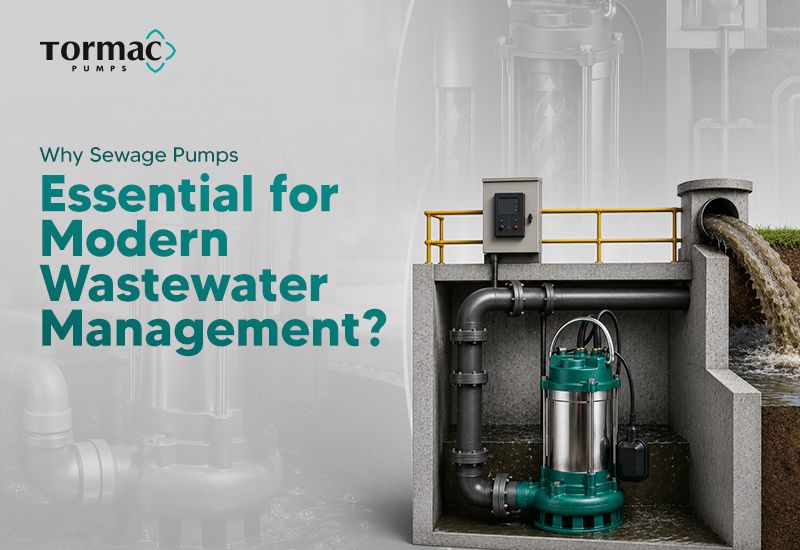
Gravity assists in moving wastewater, but it is not capable of handling all scenarios. Basements, underground facilities, low-lying areas, and tall buildings often need wastewater to be lifted or even transported over extended distances. This is where sewage pumps come in handy.
The pump, which contains a motor-driven impeller, develops centrifugal force by which it conveys not only wastewater but also solids, debris, and biological waste through discharge pipes to treatment plants or collection systems. The qualities of the impeller, casing, and seals enable the pump to cope with tough wastewater without clogging or loss of performance.
Why Standard Pumps Cannot Handle Wastewater
A simple-water centrifugal pump is not suitable for sewage. Wastewater has abrasive particles, grease, fibrous materials, and solid waste, which can cause major harm to typical pumps.
This is the reason why sewage pumps for wastewater systems are manufactured with large impeller passages, anti-clog vortex or channel impellers, heavy-duty mechanical seals, and corrosion-resistant materials. These aspects lower the need for work, raise dependability, and avert costly breakdowns of the system.
Places Where Sewage Pumps Are Installed
Residential and Commercial Buildings
Homes, hotels, hospitals, and shopping malls depend on sewage pumps put in sump pits that lift wastewater up to municipal sewer networks. Small submersible pumps are perfect when there is a very limited installation space, but good drainage is still a must.
Municipal Lift Stations
In cities, lift stations are places where sewage is brought up by pumping because it is impossible to have gravity flow. These pumping stations are working all the time, handling daily peak flows, stormwater surges, and changes in wastewater amounts. Pumps that you can trust are a must if you want to avoid stopping the sewer service for entire communities.
Industrial Facilities
Factories, food processing plants, chemical industries, and construction sites generate wastewater that is more challenging than the wastewater coming from households. Industrial sewage pumps have to be capable of resisting corrosive liquids, high temperatures, abrasive particles, and continuous-duty operation. Components made of stainless steel and strong impellers are very important for these places.
Flood and Stormwater Control
Days of heavy rain can very quickly fill up the drainage system. Sewage and drainage pumps deal with removing dirty water with the suspended solids in it, thereby protecting not only the buildings but also roads and the entire environment from flooding and contamination.
The Engineering Behind Reliable Sewage Pumps
Picking the right sewage pumps for wastewater systems involves the first step of assessing the flow rate, total dynamic head, wastewater characteristics, number of operating hours, and installation conditions.
Submersible pumps are the most common choice because they work right in the sump, they don’t have to be primed, and they are efficiently cooled by the liquid around them. The motor in a double mechanical seal pump with an oil chamber is safe from getting damaged by wastewater, and the working time of the pump is extended.
Whether it is a small residential model or a heavy-duty municipal and industrial unit, sewage pumps that are correctly sized for wastewater systems offer dependable performance, energy efficiency, and lower maintenance.
ALSO CHECK – Common Problems in Regenerative Self Priming Pumps and Their Solutions
Final Thought
To sum up, sufficiently reliable sewage pumps for wastewater systems form a very essential part of good wastewater management in residential, commercial, municipal, and industrial areas. When the right pump is chosen, the pump not only runs efficiently but hardly stops working, and also the long-term unpleasant costs of maintenance go down.
Tormac Pumps offers a complete range of sewage pumps, from TPS and TSS compact models to heavy-duty TGB, TGA, and TMC series, engineered to international standards for dependable performance. Explore the full range and connect with the Tormac Pumps team to find the ideal solution for your wastewater application.
FAQs
- What makes sewage pumps different from regular water pumps?
- Sewage pumps have wider impeller passages, anti-clog designs, durable seals, and corrosion-resistant materials to handle wastewater containing solids and debris.
- How do I choose the right sewage pump capacity?
- Consider the required flow rate, total head, solids handling capacity, and operating duty before selecting a pump.
- How often should sewage pumps be maintained?
- Most submersible sewage pumps should be inspected every 6–12 months, depending on operating conditions and usage intensity.