
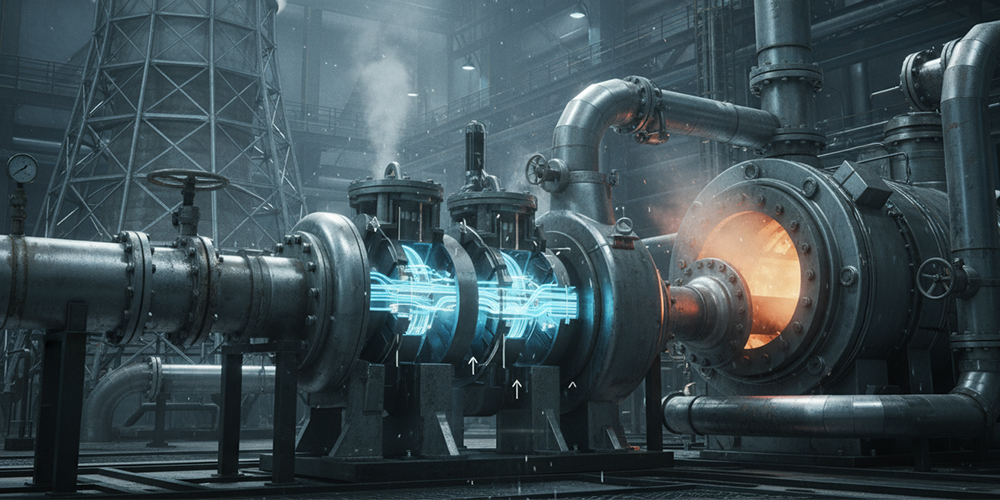
In the contemporary industrial scenario, the efficient transportation of fluids in both cooling and heating lines remains a very important factor to consider.Central to this are devices like the Tormac‑branded systems which often deploy a key piece of equipment: the Centrifugal Multistage Pump. In this blog, let us explore how these pumps are used in industrial cooling towers and boilers.
Understanding the Basics: Centrifugal Pump & Multistage Concept
A centrifugal pump is a machine that transforms mechanical energy (from an electric motor or other prime mover) into hydraulic energy through the rotation of an impeller. The impeller pushes the liquid to the outward while causing an increase in its speed and the pump body or volute turns that speed into pressure.
Now, when higher pressures or multiple stages of pressure increase are needed (for example when boosting fluid to high elevations or through boilers), one uses a centrifugal multistage pump. This type of multistage pump essentially contains two or more impellers in series on the same shaft (or separate shafts) so that each stage contributes to raising the pressure head.
Key parameters like head (the height the pump can lift water), flow, system losses (friction, piping, valves) all play a role in pump selection.
Always, analyze the architecture extended to multiple pressures‑increasing impellers, delivering higher head and often enabling smaller flow at higher pressures.
Role in Cooling Tower Water Circulation
In industrial cooling tower systems, water is circulated to remove waste heat (from processes, air conditioning, or boiler heat rejection) and then fed back to the process. The pump that circulates this water is often referred to as the cooling tower water pump. In such applications, these pumps are ideal when you need higher head (pressure) to push fluid through large systems or higher elevation loops.
Here’s how this works in a typical setup:
- The cooling tower draws warm water from the process and passes it through fills or heat‑exchange surfaces to reject heat to the atmosphere.
- The cooled water is then circulated back into the system or heat‑exchange coils.
- A cooling tower water pump pushes the water through the tower and the associated piping network.
- Because there may be long piping runs, multiple heat exchangers, elevation changes, and friction losses, the added “stages” ensure sufficient head to maintain desired flow rates.
The benefit: Consistent flow and pressure means the cooling tower can perform its duty properly, avoiding thermal imbalance and ensuring process stability.
Use as Boiler Feed Water Pump
For a boiler system, the role is quite different but equally critical. The boiler requires feed water at a certain pressure and head so that it can enter the boiler drum or heat‐exchange system without cavitation or mis‑feed. This is where the boiler feed water pump comes into play.
Why?
- To supply feed water with high pressure to overcome steam pressure, and ensure better circulation.
- To maintain flow stability under varying boiler demand (ramping up or down).
- To ensure safe, reliable operation of the boiler system (because the feed pump is a vital component failure that may lead to shutdown or damage).
- Considering that boiler systems usually require excessive pressure, whereas a basic one-stage pump might not be adequate, this is where a multi-stage one is selected instead.
In this case, the boiler feed water pump delivers the necessary height and rate, keeps the water supply correct, and assists the boiler in its proper functioning. Because of its essential role, the industrial user often opts for the very best products from well-known manufacturers to guarantee strength, maintenance, and durability.
Why Choose a Centrifugal Multistage Pump (and why by Tormac)
Here are several reasons:
- Higher Pressure Capability: A multistage unit enables stacking impellers to achieve higher head without sacrificing efficiency. This is crucial for boiler systems and tall or long cooling loops.
- Efficiency & Flexibility: This concept is inherently efficient for low‐viscosity fluids like water. When brought together in a multistage form they supply the adaptability for achieving the desired head/flow curve.
- Reliable Industrial Performance: With industrial applications such as cooling towers, boilers, etc., continuous duty, high reliability and ease of maintenance are of prime necessity. Companies such as Tormac are specialists in industrial pump systems supplying robust design, service support, and versatility.
- Optimised for Cooling & Heating Systems: Cooling tower loops often require significant head due to height, heat‑exchanger resistance, and piping. A pump designated as a cooling tower water pump with multistage capability ensures that. Similarly, when used as a boiler feed water pump, it meets the high‐pressure requirements of boiler feed systems.
- Durability and Maintenance: Multistage centrifugal pumps tend to have many of the same components as regular ones (impellers, casings, shaft, bearings) but are designed for higher duty.
Application Tips & Best Practices for Users
If you are specifying or operating a pump for a cooling tower or boiler loop, consider the following:
- Accurate System Curves: How much flow is required? What is the total head – including static lift, friction losses in piping, heat exchanger resistance, valve losses? As documented by many pump engineering references, knowing the system curve and matching it with the pump characteristic is crucial.
- Selecting the “Best Efficiency Point” (BEP): Operating near the pump’s BEP ensures energy efficiency, less vibration, and longer life. Oversizing pumps to “just in case” often leads to reduced efficiency and increased wear.
- Material Considerations: In the case of boiler feed water or cooling tower service (which may consist of treated water, chemical add-ons, or changing temperatures), ensure the pump’s materials are compatible with the water chemistry.
- Maintenance Access and Monitoring: Choose a design (horizontal vs vertical) that is accessible. Many models (including multistage designs) are available in horizontal format which improves accessibility for maintenance.
- Brand and Service Network: Using the best manufacturers ensures availability of spares, local service support, and customisation if needed. In commercial cooling or boiler systems, downtime is expensive.
- System Integration: In the case of cooling towers, the pump must be compatible with the tower fan operation, valves, control systems, and water treatment. The feed systems for boilers must include boiler control, preheat of the feed water, check valves and safety systems.
Real‑World Example: Integration in an Industrial Plant
Imagine an industrial chemical plant with a large cooling tower system and an adjacent high‑pressure steam boiler. The cooling tower loop uses a 500 m³/h circulation through multiple heat exchangers and a height difference of 25 m plus significant friction losses. The plant opts for a centrifugal pump as they are capable of delivering the required flow at the head. The multistage design ensures the pump can overcome the combined static lift, friction losses, and also handle partial load operation reliably.
Simultaneously, the boiler feed system requires feed water at 20 bar pressure to enter the boiler drum. A separate one from the same manufacturer is selected; its multi‑impeller configuration ensures that the high head requirement is met while maintaining stable flow and protection against cavitation.
Both systems benefit from the principle (efficient conversion of mechanical to hydraulic energy) and the added head capability of the multistage configuration. The use of trusted brand equipment provides the user with confidence in long‑term performance, serviceability and uptime.
Final Thought
To conclude, if you’re looking at upgrading your pump systems in an industrial facility especially for cooling or boiler applications ensuring to engage with the reputed brands like Tormac can help you examine the head/flow requirements and also ensure that the selected centrifugal multistage pump aligns with your system’s performance needs.