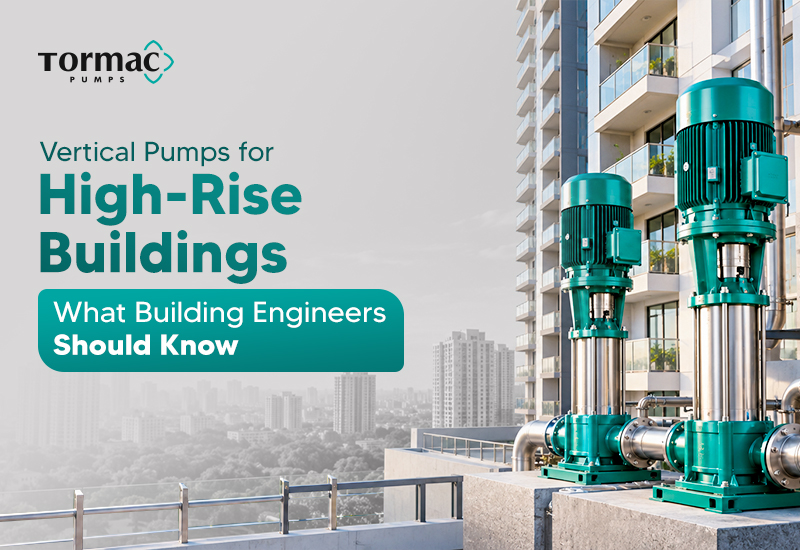
- Vertical pumps for high-rise buildings keep the top floor’s tap as strong as the ground floor’s.
- Pressure zones first, pump model second.
- Plan the standby before the plumbing.
- Noise and floor space matter on every level.
Why High-Rise Water Supply Is Tricky
Every building engineer knows the call. It’s 7 a.m., everyone is getting ready at once, and the 18th floor reports a trickle from the shower while the lobby tap runs fine.
Water has to climb, and every floor adds more head to overcome. Pressure that works for the lower floors is too weak at the top, and pressure strong enough for the top floor can burst fittings lower down. Add peak-hour demand, limited plant-room space and tenants who notice noise, and the pump choice stops being routine.
CHECK OUR PRODUCTS – Vertical Multistage Pumps
Why Vertical Multistage Works Upstairs
Vertical multistage pumps have multiple impellers that are stacked on a single shaft, and each stage is responsible for generating pressure. The pump is upright and thus requires only a small area of floor space. Where all the square metres are needed in a basement or rooftop plant room, that is counted.
Several stages also mean a high head from a compact unit. That’s what a tall building needs: plenty of pressure without a giant machine.
Work Out Your Zones
Few towers are served by one pressure level. Most are split into zones, with the pumps for each zone sized to its own height range. Lower zones may need only modest boosting. Upper zones need much more.
Always serve from the highest outlet. Add pipe friction; add the pressure at the fixture that’s the head. Then calculate the peak flow (not the average) using the number of apartments/fixings. The normal-sized pump gives people too little at 7 a.m.
Duty, Standby and Smooth Starts
A building that people live in requires more than 1 pump. Most of the designs are based on 2 or 3 pumps, with one pump being kept in standby, which means that if the pump breaks down, a hundred flats will not go dry. The smaller pumps are also able to share the load and are operated within the efficient range of a pump most of the day, when pumping loads vary from their lowest (at 12 am) to highest (at 7 am) levels.
This is well suited for variable speed control. The pumps automatically slow down when demand is reduced and accelerate when demand increases, maintaining a steady pressure and preventing the damaging start/stop effect on pipework. Night-time trickle demand may be met by a small jockey pump, which will not require the big pumps to start and stop.
Our selection chart blog describes how the two function together if you are using purely head and flow to size the pumps.
Noise, Space and Materials
Residents don’t mind pressure. They mind noise. Put the pumps on proper vibration mounts, use flexible connectors, and keep them away from bedrooms where you can.
For materials, cast iron suits ordinary domestic water. Stainless steel is the safer pick for drinking water systems, or where water quality or hot circuits call for it. The same family of pumps also serves chilled water and cooling circuits in tall buildings. We cover that side in How Centrifugal Multistage Pumps are Used in Industrial Cooling Towers and Boilers.
Selection Checklist: Vertical Pumps for High-Rise Buildings
|
Factor |
What to Confirm |
Why It Matters |
|
Pressure zones |
Height of each zone |
Avoids over- or under-pressure |
|
Peak flow |
Fixtures or flats served |
Morning peak, not average |
|
Total head |
Height, friction, fixture pressure |
Top floor gets water |
|
Standby |
Duty plus spare pump |
Building never runs dry |
|
Control |
Variable-speed drive or pressure switches |
Steady pressure |
|
Materials |
Cast iron or stainless steel |
Water quality |
|
Noise |
Mounts, connectors, location |
Fewer complaints |
|
Power supply |
50Hz or 60Hz |
Matches your grid |
How Tormac Pumps Supports Building Projects
Our TV Series vertical multistage pumps list high-rise buildings, booster systems, HVAC, and industrial water supply among their uses. On the product page, flow runs from 1 to 200 m³/hr, head from 2 to 320 m, and liquid temperature from -20°C to +120°C, in cast iron, SS 304 or SS 316.
If you’d rather have a complete package, the TVHS Series pressure boosting systems list flow of 1 to 800 m³/hr and head up to 320 m. Both come in 50Hz and 60Hz versions. Send us your building height, number of zones, and peak demand, and our technical team will shortlist a model.
Final Thought
Vertical pumps for high-rise buildings do their job quietly when the early decisions are sound. Split the building into zones. Size for the morning peak. Keep a standby ready. Pick materials for the water, and mind the noise.
Get those right and nobody on the top floor ever has to call about the shower, which is the best result a building engineer can hope for.
Planning a boosting system for a tall building? Reach out to the Tormac Pumps technical team for a pump recommendation.
FAQs
- Why use vertical multistage pumps instead of horizontal ones in a tall building?
They take less floor area and deliver high pressure from a compact unit. In a crowded plant room, that’s usually the deciding point.
- Do I need a standby pump?
Yes, in almost all residential or commercial towers. As long as one pump is temporarily out of service, the other pump will provide the necessary water and the building will retain its water.
- Is a variable-speed drive worth it?
Usually. It keeps pressure steady as demand moves through the day and takes the shock out of starts and stops.