- Start with the water source. Everything else follows.
- A vertical pump for large-scale agriculture is sized for the hottest week of the season.
- Sand and silt wear bowls fast.
- Power cost outlasts the purchase price.
Why Big Farms Lean on Vertical Pumps
Picture a large farm in peak summer. The fields are thirsty, the canal is dropping, and the pump has no day off. If it stops for a week, the crop pays for it.
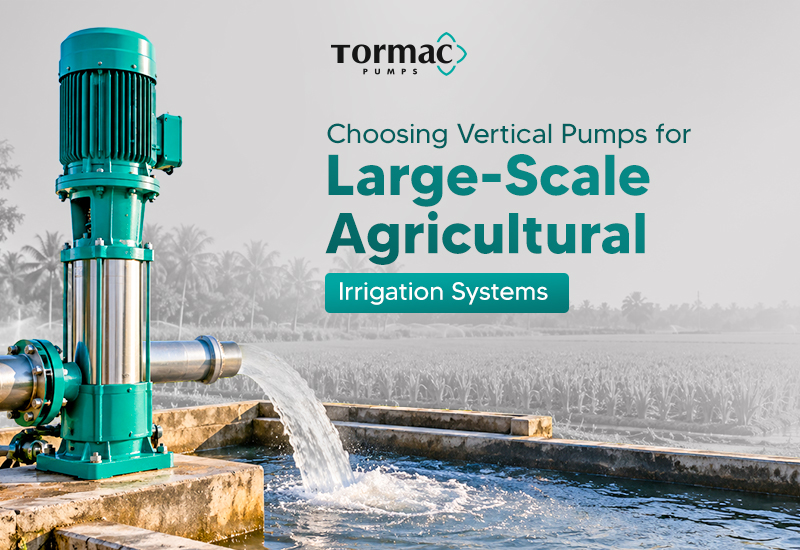
That’s the pressure behind most irrigation pump decisions. Vertical turbine pumps are a common solution, as the bowls are positioned in the water and the motor is kept above the water with a line shaft. Easy access to the motor, can pump capable of pumping a large volume of water, and can be used from rivers, canals, reservoirs, and large-diameter wells. But the catch with that is it needs to be correct the first time. Digging a pump out of a deep well in the middle of the season is nobody’s idea of fun.
CHECK OUR PRODUCTS – Vertical Turbine Pumps
Know Your Water Source First
A canal, a reservoir, and a deep well are very different, as is a river intake. Surface water changes in elevation throughout the year and, with it, transports silt. A deep well will lower as you pump it, and the water can’t be expected to be at the same level in January as it will be in May.
That is the reason why submergence is more important than the majority of buyers realize. Bowls must be covered with water at the lowest point the water in the source can get to, including the drawdown. If you get that number wrong, then the pump sucks in air, vibrates, and wears out.
Not every farm needs a turbine, though. Smaller or shallower setups are often better off with openwell or borewell pumps, and we compare the two in Borewell or Openwell Pump: Which is Better for Your Needs?
Size for Peak Season
Work out the flow your crops need in the hottest, driest stretch, then check the head. Head is more than the lift. It adds up the drop in the water level, friction in the long mains, and the pressure you need at the sprinklers, pivots, or drip filters.
Undersize it and the far end of the field goes dry. Oversize it, and you throw money at electricity for years while the pump runs off its best point. Where demand swings a lot, two or three smaller pumps can serve a big farm better than one giant unit, and a variable-speed drive helps too.
Our selection chart blog walks through how head and flow work together if you want to go through the sums.
Sand, Silt, and Materials
Surface water is rarely clean. Silt and sand scrape away at bowls, impellers, and bearings, and the damage builds quietly until output drops. A decent intake screen helps. So does choosing the right material.
Cast iron suits clean water at a lower cost. Bronze, stainless steel, or alloy steel is worth the extra money when the water is gritty, salty, or corrosive. If you’re weighing them up, here’s our blog on cast iron vs stainless steel pumps.
Energy Is the Real Bill
Irrigation pumps are operating very long hours, and over their lifetime the electricity expenditure is typically greater than the pump itself. A pump that is a few points less efficient can quietly devour the savings from a lower pump cost. Request a performance curve and ensure your duty point is within the performance-efficient range.
For fields that need extra pressure after a storage tank or filter station, an inline vertical multistage pump can boost the pressure without taking much space. See our Vertical Multistage Pumps range.
Selection Checklist: Vertical Pump for Large-Scale Agriculture
|
Factor |
What to Confirm |
Why It Matters |
|
Water source |
River, canal, reservoir, or deep well |
Sets the pump type |
|
Lowest water level |
Submergence at maximum drawdown |
Bowls stay underwater |
|
Flow |
Peak season demand |
Crops don’t wait |
|
Total head |
Lift, drawdown, friction, field pressure |
Far end of the field gets water |
|
Solids |
Sand and silt in the water |
Bowl and bearing wear |
|
Materials |
Cast iron, bronze, SS or alloy steel |
Wear and corrosion life |
|
Power supply |
50Hz or 60Hz, voltage, motor size |
Matches your grid |
|
Standby |
Spare pump or spare parts |
Peak season has no slack |
What We Build for Large Farms
Our TVT Series vertical turbine pumps are built for big jobs. The page lists flow up to 16,000 m³/hr, head up to 250 m, power up to 2,400 kW, and outlets up to 300 mm. Liquid temperature goes up to 90°C, shaft seals are mechanical or gland, and the materials are cast iron, bronze, stainless steel, and alloy steel. The product page lists irrigation among its uses.
There are 50Hz and 60Hz versions, all made under ISO 9001:2015. Need to boost pressure after the pump? Our inline TV Series multistage pumps cover that part. If you’re not sure where to start, send us your water source, the lowest water level, the flow you need, the head, and what’s in the water. The technical team can shortlist a model from there.
Final Thought
A vertical pump for large-scale agriculture does its best work when the early calls are right. Know the water source and the lowest level. Size for the hottest week. Pick materials for the water you really have. Keep an eye on power.
Get those four right, and the pump becomes the part of the farm you stop worrying about, which is the whole point.
Planning a large irrigation system? Reach out to the Tormac Pumps technical team for a pump recommendation.
FAQs
1. When is it better to use a vertical turbine instead of a submersible borewell pump?
If you are extracting water on a large scale from a river, canal, reservoir, or a large-diameter well. A borewell pump is more suitable for smaller or deeper and narrower sources.
2. What if my water carries a lot of sand?
Utilize an intake screen; choose harder materials like bronze, stainless steel, or alloy steel. Most people don’t realize that sand will wear away from the cast iron bowl faster than regular cast iron bowls.
3. Are there multiple pumps of smaller size that can take the place of a single pump?
Often, yes. A couple of smaller pumps allow you to run only as much as needed when demand shifts during the season, and one pump down doesn’t bring the entire farm to a standstill.