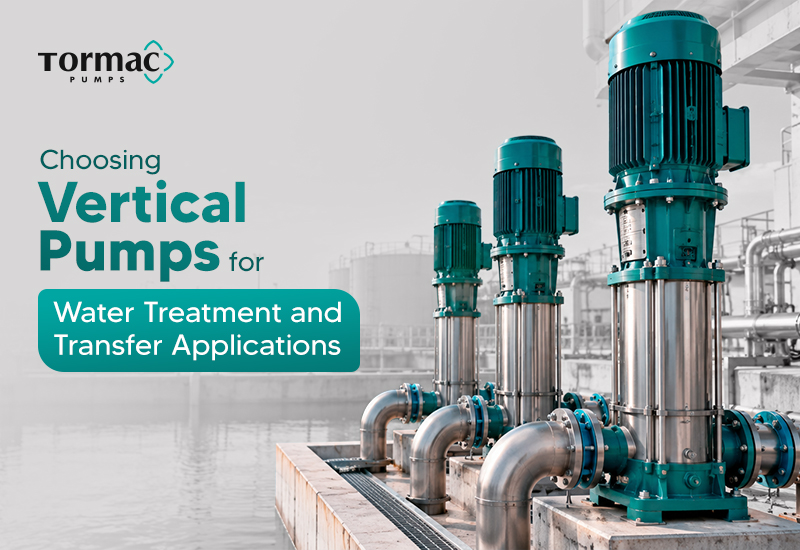
- Tight pump room? Vertical pumps for water treatment fit where horizontal sets can’t.
- Gritty raw water and clean feed water need different pumps.
- SS 304 or SS 316 depends on what’s in the water.
- Choose by plant stage first.
Why Plants Go Vertical
Pump rooms in treatment plants are always smaller than the drawings promised. Filters, tanks, dosing skids, and panels all want the same floor. A horizontal set needs a long base plus space around it to service. A vertical pump stands on a small patch and connects straight into the pipe.
Space is the first reason. Pressure is the second. Multiple stages are mounted on a single shaft, and water is forced through filters, membranes, and long pipe lengths without the need for a large motor. The problem is a pump that is ideal for a certain point in the plant may not be ideal for the next point.
CHECK OUR PRODUCTS – Vertical Multistage Pumps
What Each Stage Needs
A treatment plant is really four or five small jobs under one roof.
At the intake, the water is dirty. Leaf fragments, sand, and silt. This means it requires a pump capable of dealing with solids; in most plants, a vertical turbine suspended in a sump or intake channel.
Filter feed and backwash are cleaner, but they start and stop a lot. The water is very clean, and the pressure is high before the membranes, and that’s where the inline vertical multistage pumps excel. Finally, treated water transfer; the last step into the storage tanks or the network.
Mix these up, and it hurts. Put a multistage pump on gritty raw water, and it’ll chew through its stages in a season.
Pressure, Flow, and Why Both Move
Plants seldom operate at a single location. The filters become blocked and fluid pressure increases. There is a fluctuation in demand during the day. Tanks are either filling or emptying. A pump that is selected at a duty point is frequently used for a different purpose.
Work out the lowest and highest flow the pump will see, plus the pressure at each end. Then look at where on the curve it will spend most of its time. If it spends it far from the efficient middle, you’ll pay for it in electricity bills and early wear. Our selection chart blog walks through reading a pump curve if you want a refresher.
Materials Follow the Water
This is where treatment pumps get expensive when specified wrong. Chemically dosed water, chlorinated water, high-chloride feed. Each one attacks metal differently.
Cast iron works for plain clean water and keeps the cost down. Stainless steel is the safer choice when the water carries chlorine, salts, or chemicals, and SS 316 handles chloride-heavy water better than SS 304. We covered the trade-off in our cast iron vs stainless steel blog.
If the water ends up as drinking water, check what certification your project needs for materials that touch it. That varies by country and by client.
Selection Checklist: Vertical Pumps for Water Treatment
|
Factor |
What to Confirm |
Why It Matters |
|
Plant Stage |
Raw intake, filter feed, boosting, or transfer |
Decides the pump type |
|
Solids |
Sand, silt, or none |
Multistage needs clean water |
|
Flow Range |
Lowest and highest demand |
Stops it running off-curve |
|
Pressure |
At each end of the range |
Membranes and filters are fussy |
|
Materials |
SS 304, SS 316, or cast iron |
Corrosion, chemical contact |
|
Power Supply |
50Hz or 60Hz |
Speed, flow, and head all shift |
|
Standby |
Duty plus spare |
Plants can’t stop for repairs |
Don’t Skip the Standby
Treatment plants operate 24 hours a day and nobody wants to have to explain a shut down due to the failure of one pump. Most designs operate a duty pump and standby pump, generally duty pump alternating to ensure even wear. Install pipework and power up from the start. An added spare later will result in cutting into a live plant.
What We Build for Treatment Plants
We have a wide choice of the following pumps and systems for this type of operation: Inline TV Series vertical multistage pumps, vertical turbine pumps, and pressure boosting systems. They are available in SS 304 and SS 316, with separate 50Hz and 60Hz versions, and are manufactured to ISO 9001:2015.
If you can’t decide between the two, send us four pieces of information: The stage of the plant, your flow range, your pressure requirements, and what’s in the water. With these, the technical team will be able to trim the series and material in a single discussion. Much easier than it will be at the time of commissioning.
Final Thought
Pick the stage first. Then the pump type. Then the materials. Get that order right and vertical pumps for water treatment become one of the quieter parts of the plant, which is exactly how a pump should behave.
Working on a treatment or transfer system? Reach out to the Tormac Pumps technical team for a duty-point review.
FAQs
1. Is one vertical pump able to pump both raw water and clean water?
Usually not. A Turbine pump is used on the raw side, and an inline multistage pump is used on the clean side of duty because the raw water contains solids which tend to wear out multistage pumps quickly.
2. What are the reasons to consider using SS 316 for treatment instead of SS 304?
SS 316 is more corrosion-resistant to chlorides and chemically dosed water. When feed water is plain and clean, SS 304 will do the job.
3.Which is the right choice for me 50Hz or 60Hz?
Go by your local grid. A pump operating at one frequency is at a different speed at the other frequency, causing the flow and head to vary.