- Handles high-pressure and high-volume water transfer efficiently.
- Absorbs vibration and mechanical shock during continuous operation.
- Offers lower upfront and long-term costs than stainless steel.
- Thick walls provide strong resistance to physical damage and abrasion.
- Performs reliably across varying temperature conditions.
Why Cast Iron Works Well in Industrial Settings
At the core of water management in industries lies the use of the right type of pump. The pump’s material determines its lifespan, performance, maintenance frequency, and, ultimately, the cost it will bring to a business.
Cast iron pumps for water transfer have been the most enduring choice due to their high structural strength, ability to absorb vibration, resistance to wear, and cost-effectiveness incurred for water-intensive work conditions.
CHECK THIS TO BUY – CAST IRON PUMPS FOR WATER TRANSFER
Why Cast Iron Works Well in Industrial Settings
Cross-sectional analysis of cast iron reveals the graphite structure’s presence. It is this graphite component that gives cast iron the capacity to dampen vibrations naturally. While operating, the vibration energy is absorbed, and less stress is conveyed onto the associated piping, sealing units, bearings, and base structures.
Moreover, being compact and having a solid structure, cast iron contributes to retaining the shape of the pump’s envelope intact under prolonged periods of pressure application. In such cases, cast iron is a good match, particularly because of pipe distances, changes in height, and fluctuations caused by water use across industries.
| Cast Iron Advantage | Industrial Benefit |
| High structural strength | Handles demanding pressure conditions |
| Vibration damping | Reduces mechanical stress and noise |
| Abrasion resistance | Handles water containing fine particles |
| Thick-wall construction | Resists physical impact and wear |
| Easy machining | Simplifies repairs and restoration |
Cost and Maintenance Advantages
The industry’s decision to continue using cast iron pumps for water transfer primarily rests upon their total cost of ownership. Cast iron, as an extremely common raw material, results in reasonably foreseeable manufacturing and procurement costs. Spare parts like impellers and wear rings are also more readily obtainable at reasonable costs.
The pump material allows easy machining and repair; for example, a worn-out surface and a clearance can be put back in condition without taking the whole pump apart.
This kind of benefit makes it worth a lot, not only to the plant in terms of saving on maintenance costs but also reducing time and facility caused by repairs.
ASLO CHECK –
Applications Where Cast Iron Performs Best
Cast iron pumps are particularly suitable for applications requiring high duty cycles, reliable water movement, mechanical strength, and cost control.
| Application | Why Cast Iron Fits |
| Construction dewatering | Durable and repairable |
| Municipal water systems | Reliable for large-scale water transfer |
| Agricultural processing | Handles clean and slightly turbid water |
| Industrial water supply | Suitable for continuous-duty operation |
| Borewell extraction | Strong casing withstands installation stress |
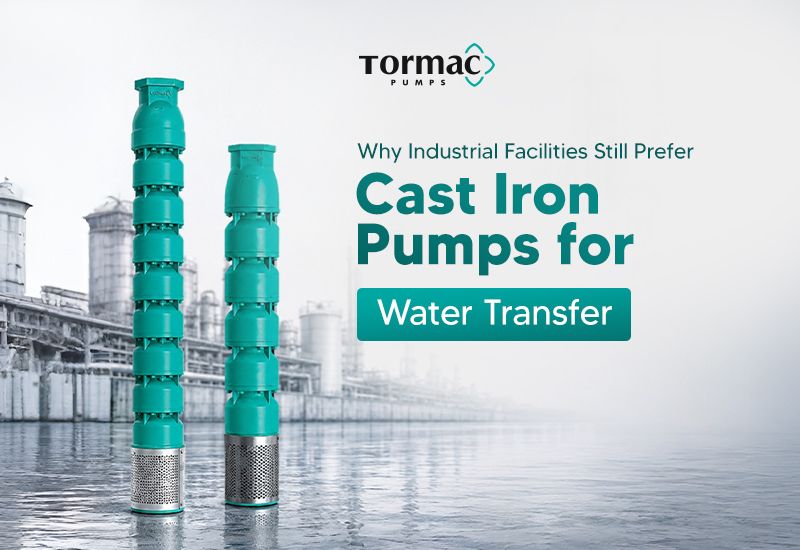
Borewell applications are one example where cast iron casings operate under the mechanical loads generated by the drilling work process and repeated lowering or retrieving of the equipment. Tormac Pumps offers a product line of TC cast iron borewell submersible pumps (in 6″ and 8″ sizes), engineered with industrial and agricultural water transfer applications in mind.
Cast Iron vs Other Pump Materials
Deciding on the best material will depend on the place of use. In the case of cast iron pumps for water transfer, for regular water uses, the trade-off between strength, durability, cost, and reparability of cast iron has proved to offer one of the best compromises.
| Material | Vibration Damping | Abrasion Resistance | Cost | Repairability |
| Cast Iron | Excellent | High | Low to Medium | Easy |
| Stainless Steel | Moderate | Very High | High | Complex |
| Thermoplastic | Low | Moderate | Low | Limited |
In circumstances where a metal is exposed to a very aggressive chemical environment or when it handles salt water, the decision is made to go for materials such as stainless steel. On the other hand, although thermoplastic materials are relatively light, they cannot offer the necessary stiffness required in tough industrial conditions.
Why Industries Choose Cast Iron
Cast iron pumps for water transfer present the perfect mix of strong and sturdy, with the added benefit of handling vibration issues, all at a reasonable price, while still being highly serviceable.
Tormac Pumps are among a few companies that produce a wide range of water cast iron pumps for industrial and agricultural purposes, which are complemented by an extensive distribution worldwide.
Final Thought
The continued preference for cast iron pumps for water transfer is gained from their proven combination of strength, durability, cost efficiency, and repairability. For industrial facilities handling standard water transfer, cast iron remains a reliable and economical material choice.
Explore the TC Series from Tormac Pumps for industrial and commercial water transfer requirements, and contact the team to discuss your application and specifications.
FAQs
- What are cast iron pumps for water transfer best suited for?
- They suit high-volume, continuous-duty applications such as borewell extraction dewatering, agriculture, and municipal water supply.
- How does cast iron compare with stainless steel?
- For standard water transfer, cast iron offers strong performance at a lower cost with excellent vibration damping and easier repairability.
- How long can cast iron pump casings last?
- With proper installation and maintenance, they can provide many years of service, depending on water quality and operating conditions.