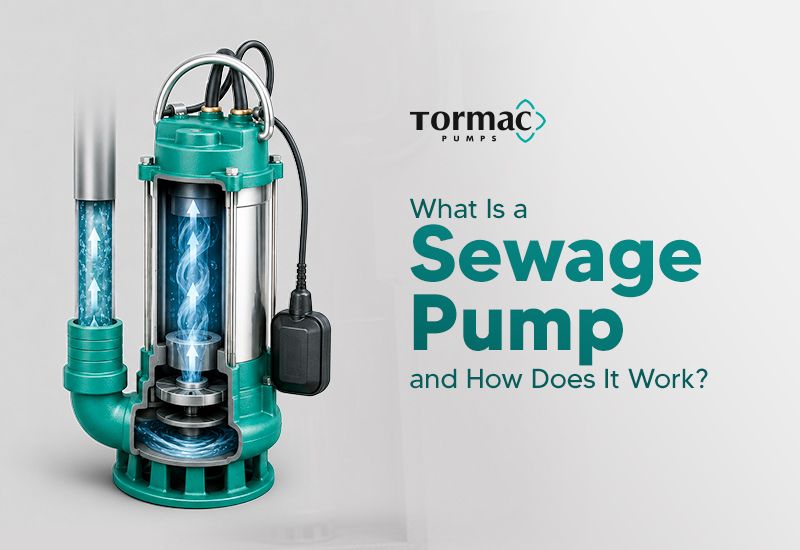
- A sewage pump moves wastewater and solids from lower to higher drainage points.
- It uses a motor-driven impeller to pump sewage through discharge pipes.
- Unlike water pumps, it is designed to handle solid waste without clogging.
- Installed in a sump pit, it starts automatically using a float switch.
- Choose a pump based on flow rate, head, solids capacity, and application.
The Invisible Engine Behind Your Plumbing
You probably never think about what happens after you flush. After all, that is precisely what it should remain – a simple process that happens automatically behind the scenes. It’s a sewage system that pumps silently and constantly takes away all waste and wastewater from your home so that there is no way to disrupt your day-to-day living.
So, What Exactly Is a Sewage Pump?
In simple terms, it is a type of submersible pump that is used to transfer the effluent, which may have a solid and liquid waste mixture, from one region to another, commonly from a low-lying level to a height where drainage is possible.
Since this kind of pump gets rid of wastewater that may not just be composed of water, it must have broader internal passageways and stronger sealing mechanisms to stop the passage of particles, solids, or even clogging. It is the strength and toughness of sewage pumps that make them suited for wastewater applications in the first place.
ALSO CHECK – Regenerative Self Priming Pumps vs Centrifugal Pumps: Which One Should You Choose?
Where Is It Used?
There are so many places where a sewage pump can be found being used, yet the majority of people may not imagine it.
For instance, basement dwellings have these pumps so that after flushing, the wastewater can still drain to the main sewer even when gravity alone isn’t possible. Similarly, hotels, hospitals, commercial buildings, and shopping malls need them because they produce quite a lot of wastewater every day without any break.
Larger versions of sewage pumps can be found in the sewage pumping stations in the cities and in heavy-duty industries, as they have the capacity to carry huge volumes of waste, and where the machines can work continuously for the time being.
Regardless, in every case where a sewage pump is put into service, one factor becomes the most important element – reliability in performance!
How a Sewage Pump Works
It’s not that hard to grasp how a sewage pumping unit is designed to work.
The sewage pump is placed into a sump well or underground reservoir where the water gathers. In other words, when waste water starts piling up in this place and reaching a point where the water level is about to overflow, a float switch inside it will send a signal to the pump to be turned on.
The pump’s blade spins, which generates a pulling effect that pulls the wastewater through the pipe and then pushes it away by spinning it with the centrifugal force to the discharge pipe leading to the sewage treatment plant.
Only when the level comes down to the minimum set-up level does the float stop the operation of the motor. In conclusion, the automatic mechanism is what makes the sewage pump run effectively in residential, commercial, and industrial wastewater systems.
What Makes a Sewage Pump Different?
The biggest difference lies in its capacity to carry away solids.
The sewage pump is designed with a broad blade that allows not only water but also solid waste to move together through the system without any pipeline risk of getting clogged by the presence of such material.
As a matter of fact, depending on the usage purpose, sewage pumps may carry either vortex impellers for greater clog resistance or channel impellers for improved flow.
The protection mechanism is another area that has a significant effect. Since the pump is placed in a water environment, high-quality and durable pumps are sealed with mechanical seals filled with an oil chamber that not only protects the engine unit from moisture but also significantly increases the pump’s service life.
The quality of all of these aspects together ensures whether a pump will function smoothly and trouble-free over the years or, on the other hand, will be prone to regular repair work.
Choosing the Right Sewage Pump
Picking the correct sewage pump is really a matter of recognizing the needs you have for yourself.
A few essential points that you need to look at during that process are:
- Flow rate – the volume of wastewater that must be moved.
- Head pressure – the vertical height the pump must lift the sewage.
- Solid handling capacity – the maximum solid size the pump can pass.
- Duty cycle – whether the pump operates continuously or intermittently.
The Tormac pumps have an excellent track record of delivering high-quality pumping solutions for homeowners as well as those running their operations on a much larger scale.
Our product portfolio spans from small compact sewage pumps of TPS, TSS series right through to large, powerful industrial, municipal sewage pumps of TMC, TKC, TMA, TAG, and TMD series. International standards are also considered in the development; as a result, the pumps are of consistent quality and performance in very diverse operating environments.
Final Thought
Sewage pumps may work out of sight, but they are essential to reliable wastewater management. Understanding how a sewage pump works also helps users choose the right pump for long-term efficiency and dependable performance.
Whether you are installing a new system or replacing an existing one, begin by evaluating your flow rate, head requirement, and solid handling needs. Choosing the correct pump at the outset improves efficiency, reduces maintenance costs, and extends equipment life.
Get in touch with Tormac Pumps to find the right sewage pump solution for your residential, commercial, industrial, or municipal application.
FAQs
- How does a sewage pump work in buildings without gravity drainage?
- Wastewater collects in a sump pit until a float switch activates the pump, showing how a sewage pump works by automatically lifting wastewater to the main sewer line.
- What happens if a sewage pump fails during operation?
- The sump pit can overflow. Critical facilities typically install a standby pump that starts automatically if the primary pump stops.
- When should a sewage pump be replaced?
- Frequent noise, reduced flow, longer operating cycles, or repeated overload trips are common signs that replacement may be the better long-term solution.