- Pump diameter must match the borewell casing size exactly.
- Water demand determines the required flow rate and HP.
- Total head increases with bore depth and delivery height.
- Proper borewell pump HP calculation prevents overload and energy waste.
- Wrong pump sizing leads to motor failure, poor flow, and high electricity costs.
Why Correct Pump Sizing Matters
Purchasing an efficient borewell pump involves more considerations than just getting a powerful motor. Water pumps that are undersized tend not to give enough water, whereas very large pumps use a lot of electricity and cause more wear to the system.
Many people first ask what size submersible pump they need when buying a pump. The answer is dependent on four main factors:
- Borewell diameter
- Water demand
- Bore depth
- Total discharge height
Even a small mistake in the borewell pump size calculation can result in problems like unreliable performance, high energy bills, and a motor that wears out quickly.
ALSO CHECK – Why Borewell Submersible Pump Motors Burn Out & How to Prevent It
How Borewell Pump Size Calculation Works
Figuring out how much water you want to use per unit time is the very first step when calculating the borewell pump size.
Flow Rate Requirement
The flow rate is the quantity of water you want, in either liters per hour or liters per minute.
The following figures give an idea of average water requirements:
- For a small home, you may require 500–1,000 liters/hour
- For irrigating a farm, you need 5,000+ liters/hour
- For commercial buildings, 2,000–10,000 liters/hour
You need to check if the pump you are buying is capable of fulfilling both:
- The actual water usage of the household or other facility
- The amount of water that the borewell can supply
If you put a heavy-duty pump in a borewell whose water flow is low, then the pump may run dry, and the motor may get overheated.
Understanding Total Head Pressure
This is one of the biggest players determining your pump size.
Generally, the total head is made up of:
- The depth of the water level in the borewell
- The level at which the water is being pumped down to
- The vertical height to the tank or point of delivery
As a rough estimate, every 10 meters of vertical lift adds about 1 bar, but the actual head also depends on friction loss and the system’s duty point.
An example of calculation:
- Depth of borewell: 100 m
- Height of overhead tank: 20 m
- Therefore, total head: 120 m
To get the water efficiently, your borewell pump motor should have the ability to generate the pressure for overcoming this whole distance.
Borewell Pump HP Calculation Explained
Knowing your exact motor power requirements is feasible through the correct borewell pump HP calculation.
Standard Formula
The formula used is:
HP = Flow Rate (LPM) × Total Head (m) / 4500
This is only a rough sizing formula. Final pump HP should be selected using the manufacturer’s head-capacity curve, system losses, and efficiency.
Example Calculation
Suppose that:
- You need a flow rate of 100 liters per minute (LPM)
- The total height is 120 meters
Therefore:
HP = 100 × 120 / 4500 ≈ 2.67
In the above example, choosing a 3 HP pump will be the most reasonable choice.
As a precaution, during borewell pump HP calculation, always work with a safety margin of about 10-15%, mainly in areas known for voltage instability.
What Size Submersible Pump Do I Need for Different Applications?
The usage and application are some of the factors that help in determining the size of the submersible pump.
Residential Applications
Generally, households:
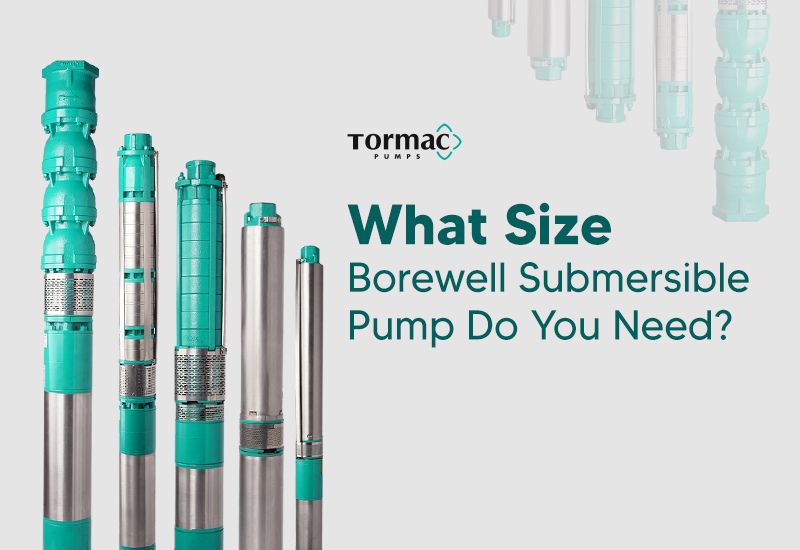
- Utilize 3″ or 4″ pumps
- Use motors that are 0.5 HP to 2 HP in strength
These would be sufficient for low water consumption and smaller-sized bore diameters.
Agricultural Irrigation
Typical farm irrigation systems call for:
- 4″ or 6″ pumps
- Motors with 5 HP to 15 HP rating
Maximum coverage with the irrigation water requires significantly high flow rates.
Commercial Buildings
Complex buildings, such as apartments or some factories, may need:
- 6″, 7″ or 8″ pumps
- Systems of 15 HP to 30 HP in power
Such scenarios require a continuous high-pressure supply.
Why Borewell Diameter Matters
The pump diameter should be such that it fits conveniently inside the borewell casing.
Example:
Choose a pump that fits the borewell casing with proper clearance; the pump size may be slightly smaller than the casing size.
For example, a 6-inch borewell may use a pump sized to fit safely within the casing with proper clearance.
You should not even think about trying to put in a pump larger than the casing, as that will result in several issues.
Material Selection Is Just As Important
Though calculating the size of a borewell pump is very necessary, the material quality eventually decides the pump’s longevity.
Stainless Steel Pumps
Best for:
- Hard water conditions
- Resistance to corrosion
- Heavy-duty continuous operation
Thermoplastic Pumps
Suitable for:
- Domestic use
- Relatively clean groundwater
- Lightweight setup
By opting for the right material, you not only enhance the device’s performance but also significantly decrease the times it will need to be serviced.
How Tormac Pumps Meets All Needs
Tormac Pumps produces borewell submersible pumps in various size configurations, like 3″, 4″, 6″, 7″, and 8″ models suitable for residential, agricultural, and commercial usages.
Some features of product variety include:
- Pumps made of stainless steel
- Variants with cast iron
- Designs in thermoplastic
- Water-filled and oil-filled motors
Tormac Pumps offers their products that support both 50Hz and 60Hz power systems, which ensures their performance remains dependable throughout the global market and diverse operational conditions.
ALSO CHECK – Low Water Flow from Borewell Pump: Reasons & Fixes
Final Thought
To conclude, choosing your borewell submersible pump rightly is more than mere dart-throwing. Proper calculation of borewell pump HP, right borewell pump sizing, and knowledge of total head pressure are some of the must-dos for achieving efficiency over a long period of time.
In case you keep thinking, what size submersible pump do I need, the right way is to thoroughly assess your flow requirement, bore depth, casing size, and power conditions prior to deciding on a model.
Trying to find a trustworthy pumping system? Check out the refined borewell pump range of Tormac Pumps and get the right one that has been top-engineered for performance, durability, and worldwide reliability.
FAQs
- How is the borewell pump HP calculation done?
- One may find the HP (horsepower) of the pump by using the pumping volume (flow rate) and the total head pressure (static head + friction head + velocity head) of the pump.
- What size submersible pump do I need for home use?
- Usually, residential uses 0.5 HP to 2 HP pumps of 3″ or 4″ size.
- Why is the borewell pump size calculation important?
- If the pump size selection is done right, it eventually avoids the pump motor from running without water (dry running), over-consumption of electricity, and also prevents motor breakdown.